
 English
 Español
 中文简体
News
Home / News / Industry News / AC/DC LED Cabinet Light Guide: Wiring Rules, Voltage Drop and Selection
A fitter opens a kitchen wall to install under-cabinet lighting and finds a 12 V transformer from an old halogen puck system, still live, with a label worn past reading. There is no mains spur beneath the cabinet and no appetite for chasing one through tile. The decision that follows — swap the transformer, rewire the run, or choose a different fixture — is exactly the decision an AC/DC LED cabinet light is built to remove.
The short answer first: a fixture rated AC/DC at 12 V carries its own rectifier, so it runs from a 12 V AC transformer or a 12 V DC driver without anyone needing to know which one is buried in the ceiling. It does not turn a low-voltage cabinet into a mains fixture, and it does not excuse poor cable sizing. Get those two points right and specification is simple. Get them wrong and you spend the next month swapping flickering lamps on a call-back.
On a datasheet, "AC/DC 12 V" describes the input the fixture will tolerate, not the light it produces. Inside the housing, a small bridge rectifier and a constant-current stage sit between the terminals and the LED board. Three practical consequences follow:
What it does not mean is that the fixture can be wired straight to 230 V. A "12 V AC/DC" rating is a low-voltage rating; the step-down still has to come from somewhere. Some catalogues also use the phrase loosely, quoting "AC/DC" on a product that has only been type-tested on DC. Ask for the input window in writing — "12 V AC 50/60 Hz and 12 V DC, operating 11–13 V" is a specification, while "12 V" alone is a hope.
Halogen-era magnetic transformers were never precision devices. On a light load they commonly sit above nominal, and a DC-only fixture connected to one may flicker, buzz or refuse to strike. The reverse case is rarer but real: a tightly regulated 12 V DC driver feeding a fixture whose input stage expects an AC zero-crossing. An AC/DC fixture closes both gaps, which is why it is the default choice for retrofit work where the existing supply is unknown until the ceiling is opened. For a deeper look at why low-voltage DC supplies are used in cabinet lighting at all, the site's note on low-voltage DC power supplies and safety standards is a useful starting point.
Most specification mistakes come from comparing fixtures on price per unit rather than on what the power path costs to deliver. The table below sets out the trade-off.
| Power option | What sits inside the fixture | Where it fits best | Main sourcing risk |
|---|---|---|---|
| AC/DC 12 V | Rectifier plus constant-current stage; accepts 12 V AC or DC | Retrofits with existing halogen transformers; OEM cabinets shipped with either supply type | Suppliers quoting "AC/DC" after testing only on DC |
| Fixed 12 V DC | DC-DC driver only; polarity marked on the body | New builds where a driver and cable plan are already specified | Flicker or non-start when connected to an AC transformer |
| 230 V AC mains | Integrated mains driver in the housing | Long runs, high ceilings, no space for a remote driver | Driver heat inside a shallow cabinet; wider certification scope |
| Portable or battery | Cell plus charge controller | Rented kitchens, display cases, walls that cannot be opened | Runtime claims that do not survive a real 8-hour shift |
At 12 V, current is roughly twenty times what the same wattage draws at 230 V, and losses scale with the square of that current. A run that looks generous on a mains circuit becomes marginal on a low-voltage one. Most luminaires are rated for operation within about ±10% of nominal voltage, and it is prudent to keep total drop nearer 5% so that supply tolerance and connector losses still fit inside the window.
Indicative voltage drop at 12 V DC, 2 A load, 2 x 0.75 mm² copper cable
Read the chart as a warning, not a table of guarantees: figures assume both conductors counted, clean terminations and no daisy-chained connectors. Two consequences matter commercially. First, a 10 m run at 2 A already eats most of the tolerance budget, so either step up to 1.0 mm² cable or move the driver closer to the cabinet. Second, an AC/DC fixture with a regulated input stage will hold brightness better on a long run than a plain 12 V DC strip — but it will not compensate for a drop so large that the input falls outside its operating window. Cable sizing still has to be done, and it is cheaper to do it at quotation stage than on site.
Decide early whether the fixture is switched on the mains side or the low-voltage side. Switching the 12 V side is convenient but leaves the transformer energised and drawing standby power around the clock; in a hotel with two hundred rooms that becomes a measurable line item. Switching the mains side is cleaner but needs a switch position that a guest can find in the dark.
A driver buried behind a sealed back panel is a future demolition job. Keep it in a serviceable position — inside a cupboard, above a plinth, or in a remote enclosure — and leave at least the manufacturer's stated clearance. Heat is the single most common reason a low-voltage supply fails inside its warranty period, and cabinet interiors are often the warmest, least ventilated space in the kitchen.
Two dimming architectures get mixed up constantly. Dimming the 12 V supply with a trailing-edge dimmer is not the same as dimming inside the fixture with pulse-width modulation. Put the two together and you get buzz, stepped response or a narrow usable range. Fix the method in the specification before the samples arrive.
An aluminium profile dissipates heat far better than a thin plastic shell of the same footprint, which is why profile-style fixtures hold their output longer. IP20 is adequate for a dry cabinet interior; anything near a sink, a steamer or a dishwash line needs a higher rating and a gasket that survives being wiped down.
The clearest case is the retrofit: an existing 12 V halogen system, a mixed stock of transformers across a building, and no reliable record of what was installed when. The second is the OEM cabinet maker who ships units to several markets and cannot control which power supply the end customer will use. In both, the AC/DC input removes a variable rather than adding a feature. A representative example is the
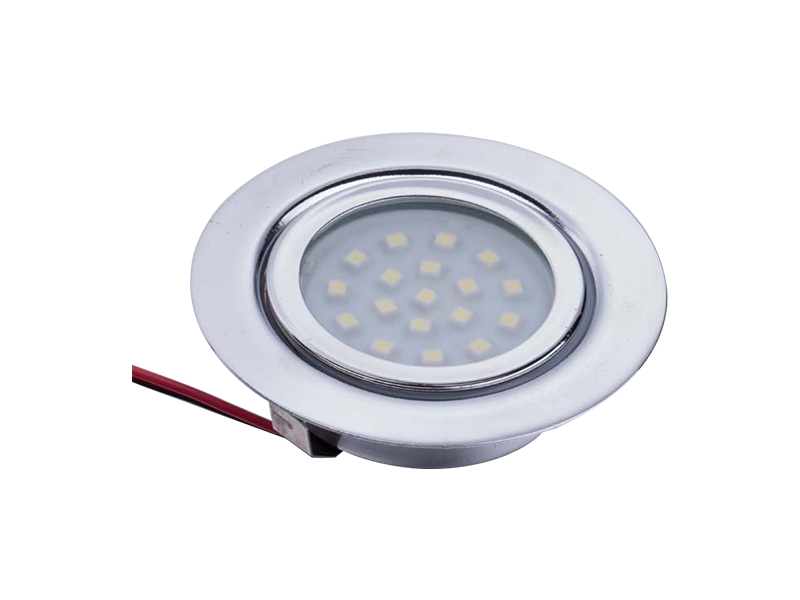 K-004 AC/DC 12V LED Cabinet LightLow-voltage under-cabinet fixture with AC/DC 12 V input, suited to retrofit projects where existing halogen supplies vary.View Product →
from the company's cabinet range, which is rated for 12 V AC or DC input and sits in the same family as the rest of the under-cabinet line.
Display and retail cabinetry is a third case. Shelving is often re-merchandised, and a fixture that survives being moved between a 12 V AC lighting bus and a DC driver saves a whole afternoon of rework. For a broader view of how to match fixture type to cabinet layout, the guide on choosing the right LED cabinet lights covers mounting depth, beam angle and colour temperature in more detail.
Two alternatives cover the cases where a 12 V feed is simply not available or not wanted. Magnetic fixtures attach to a steel shelf or a magnetic track without tools, which suits rented spaces and frequent layout changes — the
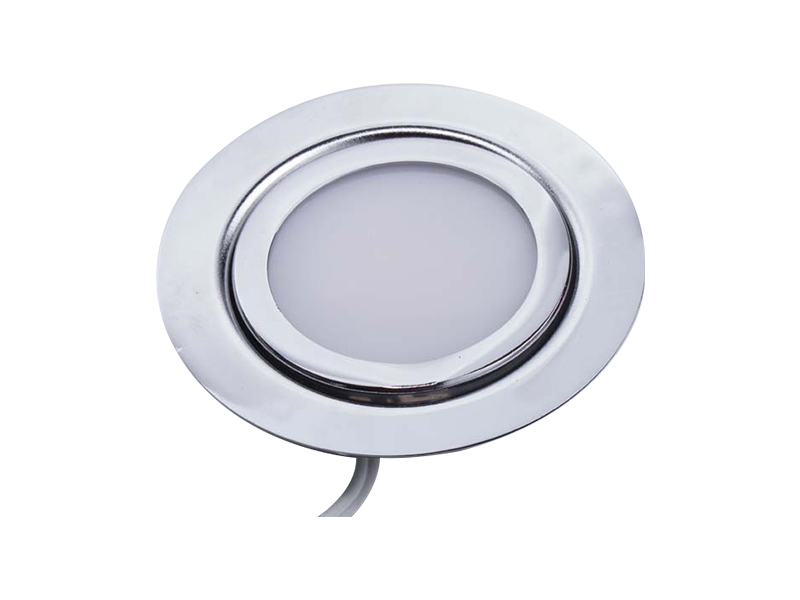 K-003 Magnetic LED Under Cabinet LightMagnetic under-cabinet light with AC/DC 12 V input, suited to tool-free mounting on steel shelves or tracks in changing layouts.View Product →
is the relevant model here. Where a mains spur does exist and a permanent, tamper-resistant installation is preferred, a hardwired unit removes the transformer question entirely; the
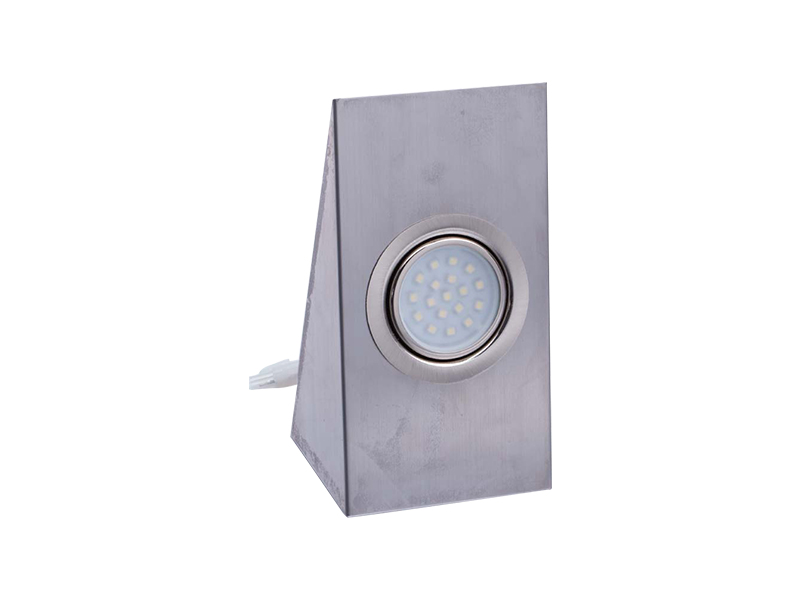 DK-015 LED Under Cabinet Light HardwiredHardwired under-cabinet fixture for permanent installations with an existing supply, reducing transformer selection in fixed layouts.View Product →
is the mains-side option in the same range.
Whether the order is fifty units or five thousand, the same nine questions separate a smooth project from a container of returns.
None of these questions is exotic, and a manufacturer with genuine production experience will answer them without a week of internal email. Ningbo Eastkey, which has built mirror and cabinet lighting in Ningbo since 2007, publishes an AC/DC cabinet model within a range that also covers hardwired, magnetic and portable formats — useful when a single project needs more than one mounting type from one supplier.
An AC/DC LED cabinet light is a small specification decision with an outsized effect on installation cost. It removes the guesswork about which power supply is behind the plasterboard, it tolerates the loose regulation of older transformers, and it keeps a mixed building on a single part number. What it cannot do is rescue a cable run that was never sized for 12 V, or a driver boxed into an unventilated cavity. Settle the voltage window, the cable length and the dimming method before the order goes out, and the rest of the installation tends to look after itself.
top

E-mail:[email protected]

Telphone:+86-574-88073028

FAX:+86-574-88073029
QR code on
mobile phone