
 English
 Español
 中文简体
中文简体News
Home / News / Industry News / LED Bathroom Lighting Guide: Lumens, CRI, IP Ratings and Vanity Light Layout
Stand in front of a freshly fitted bathroom mirror after a hot shower and three problems can appear at the same time: a face in shadow, skin that looks grey, and condensation forming inside the light fitting above the glass. None of that is bad luck. Each one traces back to a decision made on paper - light quantity, colour rendering, protection rating - and each is cheap to correct before you buy and expensive afterwards.
The short version: plan 50-75 lumens per square foot of bathroom, specify CRI 90 or higher for anything near the mirror, and choose IP ratings by zone rather than by appearance. Once those three values are settled, colour temperature, dimming, sensors and anti-fog become refinements instead of repairs.
Most complaints about LED bathroom lighting are specification failures, not product failures. A fixture that dims badly, fogs up inside or renders skin badly was usually selected from a photograph and a wattage figure, with no target values written down anywhere.
| Specification | Practical target | What it controls | Typical failure when missed |
|---|---|---|---|
| Light quantity | 50-75 lumens per sq ft (about 540-800 lumens per sq m) | Overall brightness, safety and comfort | One 800-lumen ceiling light for a 6 sq m room, leaving dark corners and a shadowed face |
| Colour rendering (CRI / Ra) | Ra 90 or above, with R9 above 50 where the supplier can confirm it | How skin, towels and tiles actually look | Ra 80 flattens red tones, so skin looks grey and warm finishes look dusty |
| Ingress protection (IP) | IPX4 minimum in zones 1 and 2, IPX7 only where immersion is possible | Survival in steam, splashes and cleaning | Fogging inside the lens, pitted chrome and nuisance tripping |
Ask for these values in writing before a sample is approved. A supplier who can only quote wattage is not answering the question of how the room will look in two years.
One ceiling fixture rarely lights a bathroom well, because the room does several jobs at once: dressing, shaving, showering and finding the way at 3 a.m. without waking anyone. Splitting the load into layers keeps each task comfortable and makes dimming genuinely useful.
The bars show relative values, but the totals matter: a 6 sq m bathroom usually lands between 3,000 and 4,500 lumens across all fixtures. That is why an 800-lumen ceiling light can feel bright in the room and still leave the mirror area too dark, and why adding light at the mirror beats adding a second ceiling fitting.
Task lighting at the mirror follows one rule that decides everything else: light must reach the face from the front. A downlight mounted directly above the mirror throws light onto the top of the head and leaves the eye sockets and the area under the nose in shadow.
Two layouts work in practice. Twin vertical fixtures of roughly 600-760 mm each, set either side of the mirror at face height, light both cheeks evenly. A single horizontal fixture also works if it spans at least 610 mm and sits in front of the glass rather than above it; backlit mirrors look striking but deliver very little usable task light on their own.
Those trade-offs matter more than wattage, and this walk-through of how to choose the best LED mirror light for your bathroom is a useful companion to a specification sheet when forms are still open.
Integrated mirror lights simplify the geometry by fixing the diffuser on the face side of the glass, so the light source keeps a constant distance from the user. A touch-controlled front mirror light, for example, removes both the separate wall fixture and the wall switch inside a wet zone.
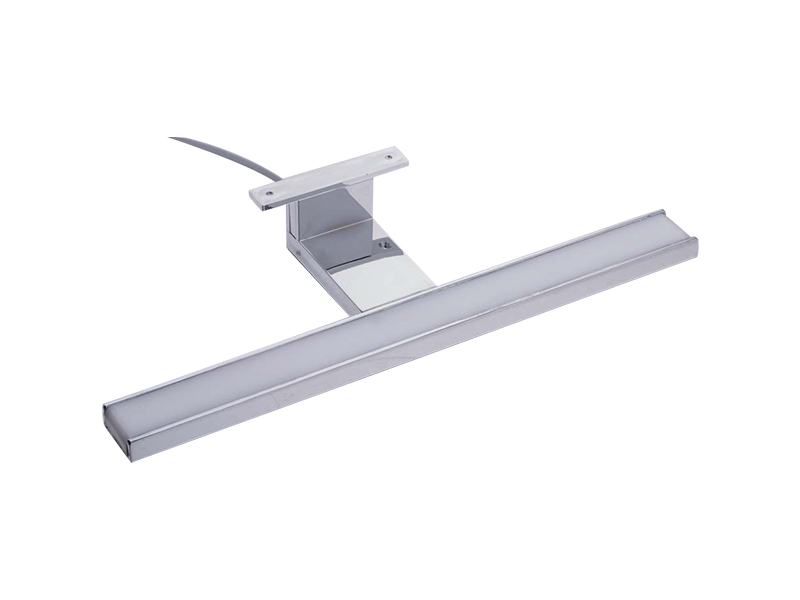 DK2513 Custom Touch LED Bathroom Mirror LightTouch control removes wall switch in wet zones; IP44-rated aluminum and ABS body with adjustable 3100K/4100K/6400K CCT and 4.5W LED.View Product →
Steam is the part of bathroom design that photographs never show. IP ratings describe how well a fitting copes with it, and the zones are straightforward:
Anti-fog is a separate question from IP. A pad behind the glass is a thin heater, typically 10-40 W, switched by a 15-60 minute timer; it holds the mirror surface above the dew point of the room air so condensation never forms at all. That is a different mechanism from a surface coating, which wears away, and it is worth knowing which one a supplier is offering.
Corrosion is the slow failure. Chrome-plated zinc and untreated steel pit within a couple of seasons once humid air and shampoo residue sit on them, while aluminium shells, tempered glass and sealed diffusers hold up far better.
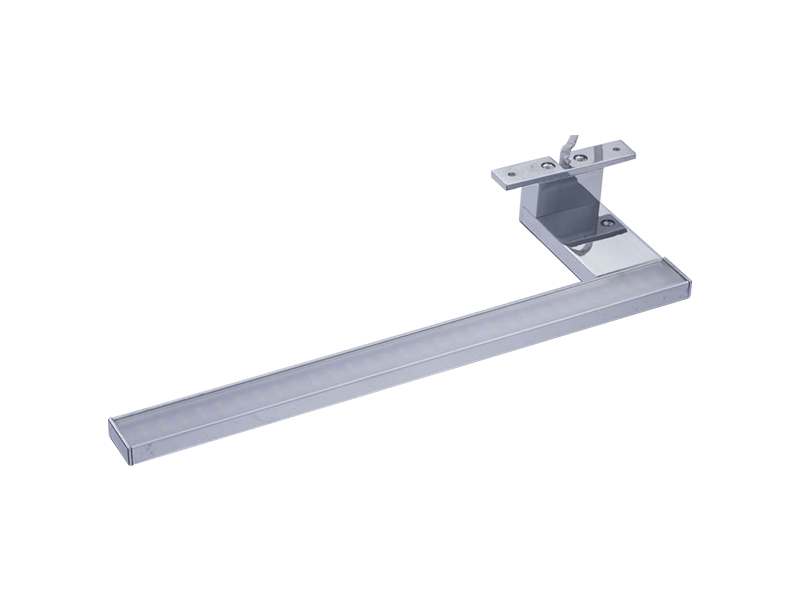 DK2511 Custom Anti-Fog Bathroom LED Mirror LightAnti-fog function, aluminum body resists corrosion, IP44 for humid bathrooms, and selectable 3100K/4100K/6400K CCT help keep mirror clear.View Product →
Colour temperature is where two reasonable decisions can cancel each other out. Residential bathrooms generally read well at 2,700-3,000 K, while 3,500-4,000 K suits makeup use, hotel bathrooms and rooms with little daylight. Mixing a 4,000 K ceiling with a 2,700 K mirror light makes the wall between them look dirty, so keep one CCT for the room, or two at most with a clear reason.
Check the delivered tolerance, not just the nominal figure. A batch spread of plus or minus 150 K is visible when two mirrors sit side by side on the same wall, and asking for that figure in writing is entirely normal.
CRI matters even more. At Ra 80, red tones flatten and skin looks grey; at Ra 90 and above, with R9 above 50, lips and skin keep their colour. That single number often decides whether a mirror is a pleasure to use or one people avoid.
Dimming exposes cheap electronics faster than anything else. A trailing-edge dimmer with a compatible driver fades smoothly to roughly 5-10%, while a leading-edge dimmer on a non-dimmable driver buzzes, flickers and strobes at low output in a way phone cameras pick up immediately. For larger installations, 0-10 V or DALI control and a flicker figure inside the IEEE 1789 low-risk band belong in the written specification.
Sensors solve small daily problems. Touch switching removes the need for a wall switch inside a wet zone, and PIR sensing handles night visits; set the hold time between 30 seconds and 5 minutes, and check the detection cone so a shower door or a passing pet does not trigger the light. On combined units, the defogger timer and the dimmer should work independently, otherwise one function drags the other along with it.
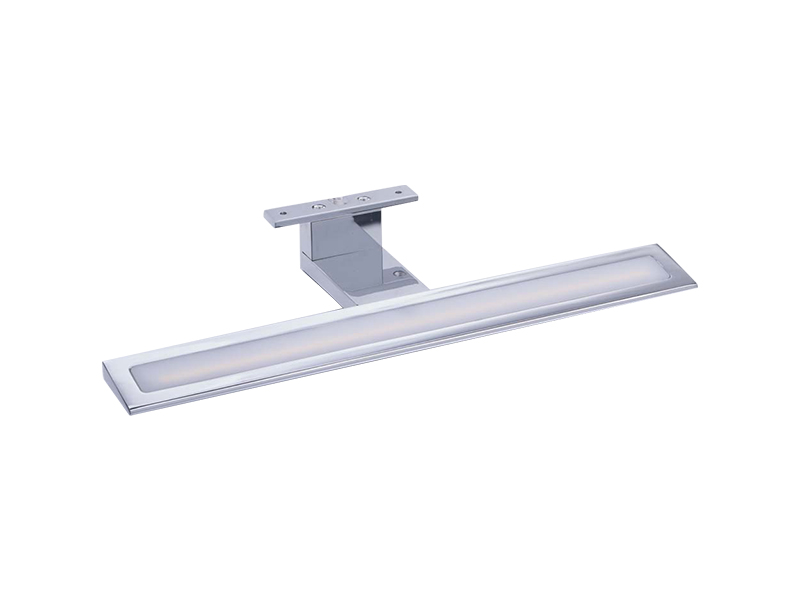 DK2512 Backlit Dimmable LED Mirror Light with DefoggerBacklit, dimmable, and defogging functions in one IP44-rated aluminum unit; 8W LED with adjustable 3100K/4100K/6400K CCT.View Product →
Working in this order keeps a specification short and stops the usual loop between zones, features and price:
Layer the room first, then specify each fixture
Zone first, because it constrains everything else. Then IP, then the lumen target for that layer, then CRI and CCT for anything close to the mirror, and only then control type, finish and switch placement.
Volume buyers rarely lose money on the visible parts of a mirror light. They lose it on tolerances, which only show up when a container is opened. Before confirming an order, ask for:
Customisation is usually the easier problem: length, finish, sensor type and cable exit can all be adjusted when the tooling already exists.
For buyers working outside standard sizes, the practical starting point is a maker that already runs mirror light tooling, which is where our bathroom lighting range sits.
LED bathroom lighting comes down to five lines on a specification sheet: zone, lumens, CRI, CCT and control. Write them down before comparing prices, and the sample you approve will match the shipment you receive. Skip them, and no amount of styling will hide a shadowed face or a mirror that fogs over every morning.
top

E-mail:[email protected]

Telphone:+86-574-88073028

FAX:+86-574-88073029
QR code on
mobile phone