
 English
 Español
 中文简体
News
Home / News / Industry News / LED Bathroom Lighting Manufacturers: How to Vet Suppliers for Your Project
During a recent sourcing inspection, a European distributor tested samples from three LED bathroom lighting manufacturers shortlisted for the same vanity light order. Two units failed the 48-hour humidity test: the aluminum backplates oxidized and the color temperature drifted by nearly 400 K. The third unit, fitted with a sealed LED driver and a powder-coated housing, ran for 72 hours with no measurable drift. The price difference between the three quotes was less than 8 percent.
The takeaway is straightforward. The right supplier is not the one with the lowest quote, but the one that can prove consistent electrical safety, moisture protection, and production control. This guide explains how to evaluate LED bathroom lighting manufacturers from a buyer's perspective: what to check in the specifications, what to ask during negotiation, and what level of capability you should expect from a factory that specializes in bathroom fixtures.
Bathroom lighting is not the same as general indoor lighting. The environment combines humidity, condensation, and occasional direct splashes, so the manufacturer's approach to moisture protection is the first thing to verify.
Most international markets follow the zoning rules in IEC 60364-7-701. A fixture installed directly above a bath, or within 60 cm of a washbasin, must resist splashes, which means a minimum IP44 rating. Fixtures inside the bath zone, or those likely to be cleaned with a hose in commercial facilities, should be IP65 or better.
| Bathroom zone | Typical location | Minimum IP rating | Common fixture type |
|---|---|---|---|
| Zone 1 | Directly above bath or shower | IP44; IP65 if jets are installed | Recessed mirror light, ceiling light |
| Zone 2 | Within 60 cm of bath or basin | IP44 | Vanity light, wall-mounted mirror light |
| Zone 3 | Beyond 60 cm from water sources | IP20 minimum; IP44 recommended | Decorative mirror light, cabinet light |
The IP rating tells only part of the story. Ask the manufacturer which part of the assembly is sealed: a light can carry an IP44 label while the driver housing remains open at the back. Responsible manufacturers test the complete unit, not just the LED board.
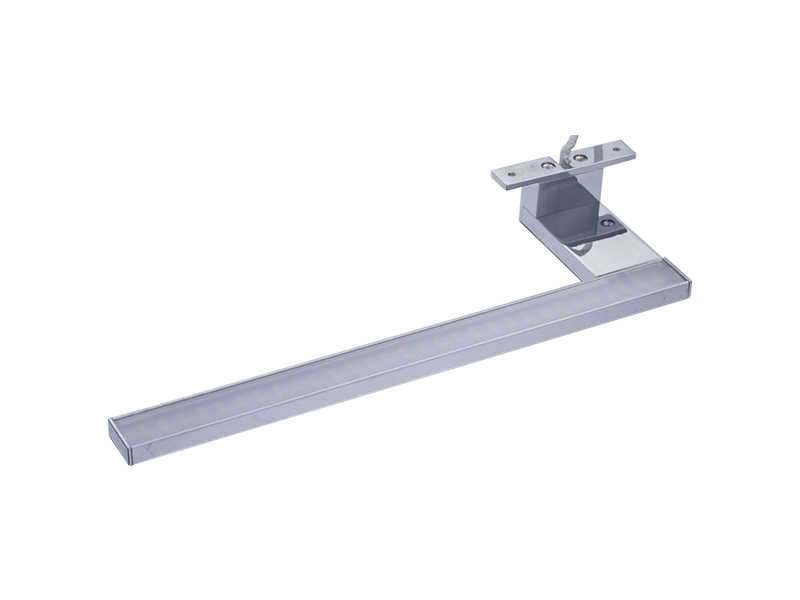 DK2511 Anti-Fog Bathroom LED Mirror Light with IP44 RatingThis anti-fog mirror light pairs LED illumination with fog prevention. Given the earlier emphasis on sealed assemblies and driver protection, check that the full unit is tested and the driver includes safety features.View Product →
Bathroom fixtures should be SELV (safety extra-low voltage) or Class II insulated. SELV designs run on 12 V or 24 V DC, which reduces the risk of electric shock in wet conditions and simplifies installation without an earth connection. The LED driver itself matters just as much as the light source: a constant-current driver with short-circuit, overvoltage, and overheating protection prevents premature failure. When you request a quote, ask which driver brand and model the factory uses, and whether the finished light carries CE, UL, or ENEC marks. Also confirm that the LED module is flicker-free, since bathroom users notice strobing when applying makeup or shaving.
Anodized or powder-coated aluminum is the standard housing material for LED mirror lights because it conducts heat away from the LEDs and resists corrosion in humid air. Check whether the manufacturer uses stainless steel screws and sealed gaskets, and whether the surface finish has passed a salt-spray test. A mirror light that looks identical to a competitor's at first glance may use a thinner aluminum profile and untreated hardware, which is why samples and material specifications should be part of the evaluation.
A manufacturer that genuinely serves the bathroom lighting segment can offer more than one fixture type. When you evaluate a catalog, check whether the range is organized by application: an experienced LED bathroom lighting manufacturer will group mirror lights, vanity fixtures, and cabinet lights into separate product lines with clear specification sheets.
Mirror lights are the core of most bathroom lighting orders. A typical project needs a unit with 300–600 lumens, a color temperature around 4000 K, and a CRI of at least 90 so skin tones look natural. Anti-fog versions use a heated film behind the glass, and backlit designs distribute light evenly across the mirror surface instead of creating hotspots. If you are comparing models, our practical guide on how to choose the best LED mirror light for your bathroom covers the main selection criteria in more detail.
Above-mirror vanity fixtures remain the fastest-moving category in the bathroom segment because they suit standard bathrooms where the mirror is mounted on the wall. A distributor's typical order covers five to eight SKUs per model family, with variations in color temperature and finish. Cabinet lights, meanwhile, are ordered separately for storage areas and under-counter task lighting; hardwired versions are popular in new construction, while magnetic and portable lights suit retrofit projects.
 DK1037 LED Vanity Light for Above-Mirror InstallationsA stainless steel vanity light suited for standard bathrooms. The preceding discussion highlights motion sensors and custom SKUs; this model offers adjustable color temperatures and can be adapted for commercial projects.View Product →
Motion sensor control is one of the most requested additions in hotel and commercial bathroom projects. A passive infrared sensor switches the mirror light on when someone approaches and turns it off after a set delay, which cuts energy use and gives a premium feel. Dimmable drivers and touch controls are also common, either combined with a sensor or supplied as standalone options. Confirm whether the factory offers these features as standard SKUs or as low-cost modifications to an existing model.
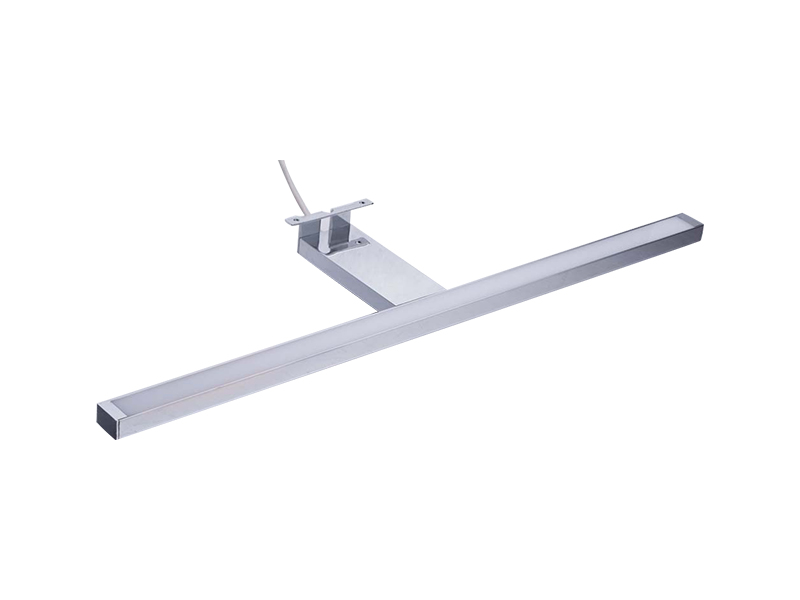 DK-1140 LED Sensor Mirror Light for Energy-Efficient BathroomsEquipped with a sensor for automatic on/off, this mirror light supports customization in color temperature and finish. Ideal for hotels or premium bathrooms where motion-activated lighting is a key requirement.View Product →
Most LED bathroom lighting projects involve some level of customization. The most common requests are dimensional changes to fit a specific mirror size, color temperature selection (2700 K, 3000 K, or 4000 K), driver output adjustment for dimming, and CRI upgrades to 95+. Logo printing, carton design, and packaging inserts are usually part of the order as well.
Lead times vary by order type. A manufacturer with its own production line will quote standard catalog products in two to three weeks from the confirmed order, while OEM and ODM work takes longer, as shown below.
Figure 1. Typical lead time from confirmed order to shipment
Before placing an order, require a sample of any customized model. The sample verifies the color temperature, light distribution, and mechanical fit, and it gives you a reference piece for the final quality inspection. Ask the factory for its sample policy in writing: who pays for tooling, how many samples are provided, and whether the sample cost is deducted from the first production order.
Working directly with the factory matters for a simple reason: it shortens the communication chain. When the company you talk to owns the production line and the quality inspection equipment, decisions about material thickness, driver selection, or finish can be confirmed during the same call. A manufacturer with a stable track record should also be able to state its founding year, export markets, and typical monthly output.
Eastkey, for example, is a Ningbo-based lighting manufacturer founded in 2007 that specializes in LED mirror lights, halogen mirror lights, and LED cabinet lights. It operates its own workshop, warehouse, and inspection equipment, and it publishes a 12-hour response commitment on working days. That kind of transparency gives a buyer a clear baseline when calculating lead times and negotiating custom orders.
Choosing an LED bathroom lighting manufacturer ultimately comes down to evidence, not promises. Check the IP rating of the complete unit, verify the driver and materials, request samples, and confirm the customization process in writing. A supplier that answers these points quickly and with data is the one worth putting on your shortlist.
top

E-mail:[email protected]

Telphone:+86-574-88073028

FAX:+86-574-88073029
QR code on
mobile phone