
 English
 Español
 中文简体
News
Home / News / Industry News / LED Bathroom Lighting Manufacturers: What Buyers Should Verify Before Ordering
A buyer opens three sample boxes from three LED bathroom lighting manufacturers. Each mirror light looks similar on the outside: a slim aluminum frame, a frosted diffuser, a 3000K label, and a promise of “anti-fog.” Then the questions start: Is the driver sealed? Does the anti-fog pad cover the mirror center or only a strip? Can the sensor still work behind a 6 mm mirror? What happens after 500 on/off cycles in a steamy bathroom?
The short answer: choose a manufacturer by evidence, not by catalogue photography. For LED bathroom lighting, the real differentiators are moisture protection, driver quality, control reliability, and repeatable QC. Price matters, but a low unit price that produces field returns is expensive. The checks below help narrow a supplier list before you commit to tooling, samples, or a bulk order.
Bathroom lighting sits in a harsh environment: humidity, soap film, cleaning chemicals, temperature swings, and occasional splashes. A decorative mirror light can pass a showroom inspection and still fail in a hotel bathroom within a year if the driver compartment is not sealed or the chrome is too thin. Ask for the IP rating with the exact test position, not just “IP44” on a spec sheet. For mirror lights in a bathroom zone, IP44 is a common baseline; closer to a shower or bath, the required protection may be higher. The driver should be accessible for replacement without destroying the mirror, and the sealing should survive cleaning, not only installation.
 DK1037 LED Bathroom Vanity Light for Above-Mirror InstallationIP44 stainless-steel vanity light with selectable 3100K/4100K/6400K color temperatures and chrome or satin finish, suited to bathroom mirror lighting.View Product →
Also ask for the practical details that affect installation: mirror thickness range for sensor models, wall-mount bracket dimensions, cable entry position, and whether the driver is integrated or remote. A supplier that can answer these questions quickly usually has better production discipline. A supplier that sends only a generic PDF is a risk.
| Evaluation area | What to verify | Relative weight |
|---|---|---|
| Moisture and corrosion protection | IP rating, sealed driver area, humidity or salt-spray test, finish thickness | High |
| Driver and electrical safety | Driver specification, overload protection, flicker performance, certification documents | High |
| Optical quality | CRI, color consistency, glare control, diffuser evenness | Medium-high |
| Control reliability | Touch or motion sensor life, dimming range, anti-fog timing | Medium-high |
| Installation and service | Bracket fit, mirror thickness range, replaceable driver, clear wiring diagram | Medium |
The weighting is not universal. A hotel refurbishment may push moisture and serviceability higher; a retail lighting range may care more about CRI and design consistency.
Anti-fog is one of the easiest features to claim and one of the easiest to get wrong. A small heating pad may clear a hand-sized patch, not the full mirror. Ask for the heated area, warm-up time, and power consumption. For a 700 x 500 mm mirror, a patch of 200 x 300 mm is visible after a shower. The control logic matters too: does the anti-fog turn on with the light, with a separate switch, or with a sensor? A separate switch is simpler; a sensor is more convenient but adds a failure point.
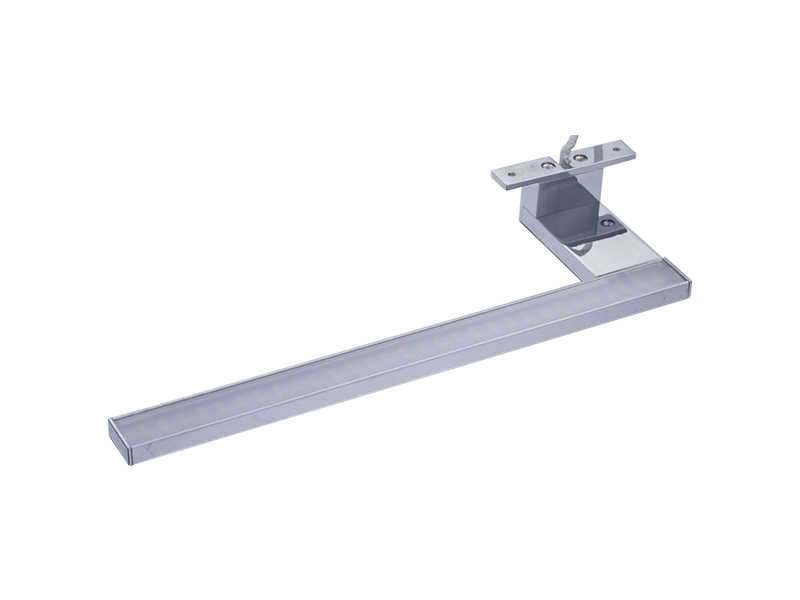 DK2511 Anti-Fog LED Mirror Light for BathroomsAluminum IP44 anti-fog mirror light with 350 lm output, selectable 3100K/4100K/6400K temperatures and chrome or satin finish; check heated area and controls.View Product →
Sensor and dimming performance should be tested with the actual mirror thickness and finish. A touch sensor behind a thick mirror may be sluggish; a motion sensor may trigger through a glass door or fail in low light. Dimming should be smooth at the bottom 10%, not just at full brightness. For a broader selection checklist, see this guide on how to choose the best LED mirror light.
Aluminum, steel, chrome, glass, and acrylic all behave differently in a bathroom. Aluminum is common for mirror-light frames because it resists rust when properly coated, but the coating thickness and edge sealing decide the outcome. Chrome can look premium, yet thin plating over a poor substrate can pit around fixings. Glass edges should be polished or protected; sharp edges are a handling risk and a sign of loose process control. If the product includes a shelf or storage, check how water drains and whether the internal surfaces can be cleaned.
For cleaning, ask what chemicals the finish tolerates. Many bathroom failures come from abrasive or acidic cleaners, not from normal humidity. A manufacturer that supplies a simple care card and a tested cleaning list is easier to work with than one that says “clean with a soft cloth” and nothing else.
Touch switches, motion sensors, defogger timers, and dimmers add electronic content to a wet area. Request the control board layout, conformal coating, and protection against overload or short circuit. A mirror light can have a good LED module and still fail because the sensor board is not protected from condensation. Also check flicker: a camera test on a phone can reveal banding that is invisible to the eye but annoying in video calls and hotel bathrooms.
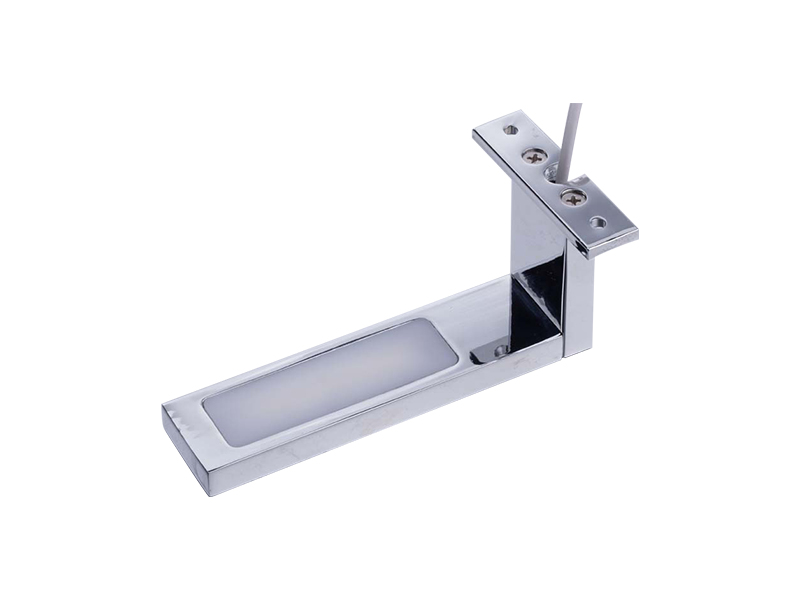 DK914 Motion-Sensor LED Bathroom Mirror LightAluminum IP44 motion-sensor mirror light with 280 lm output, selectable 3100K/4100K/6400K temperatures and chrome or satin finish; verify sensor and compliance details.View Product →
Compliance is a document trail, not a logo wall. Ask for the applicable test reports, certificate numbers, and the standard behind each claim. The exact requirements depend on the destination market, so keep the conversation specific: voltage, plug or wiring type, IP rating, driver safety, and packaging marks. Do not accept a generic “CE” image as proof; ask which directive and which test file.
A factory visit is useful, but a sample test is faster. Order two or three units from the production line, not from the showroom, and run them in a bathroom or humidity chamber for a week. Check the driver temperature, sensor response after steam, finish condition around screws, and light output after repeated switching. If the supplier cannot provide production-line samples, the sample is not representative.
For buyers sourcing from China, the operating style of the manufacturer matters as much as the catalogue. Ningbo Eastkey Illuminate Appliance Co., Ltd. is a Ningbo-based manufacturer of mirror lights and cabinet lights, with LED mirror-light models covering anti-fog, sensor, touch, dimmable, and heated functions. The company states that it supports custom orders and replies to inquiries within 12 hours on working days. Use those claims as questions for the first call: ask for a model that matches your mirror size, your IP requirement, and your market’s certification file.
Score each supplier on the same five lines: moisture protection, driver quality, control reliability, optical consistency, and delivery discipline. A simple 1-5 score per line is enough; the value is in comparing evidence, not in the exact number. A supplier with a 4 on driver quality and a 3 on finish may be better than a 5 on catalogue design and a 2 on QC, especially for hotel or multi-unit projects.
Finally, calculate the landed cost of a failure. Add the replacement unit, freight, labor, and the risk of a bad review or a delayed project. That number usually changes the shortlist. The right LED bathroom lighting manufacturer is the one that can show you the IP test, the driver specification, the sensor test, and the production sample, then repeat the same result in the next order.
top

E-mail:[email protected]

Telphone:+86-574-88073028

FAX:+86-574-88073029
QR code on
mobile phone