
 English
 Español
 中文简体
News
Home / News / Industry News / LED Bathroom Mirror Manufacturer: How to Vet Specs, Certifications & Lead Times
A 300-piece order of backlit mirrors with demisters looks simple on paper. Then the first container arrives and a third of the units flicker, buzz, or leave a stubborn patch of fog on the glass in winter. In most cases the mirror is not the problem. The LED driver, the demister wattage and the IP rating were settled months earlier, long before the purchase order was signed.
So the conclusion first: qualify the LED bathroom mirror manufacturer before you negotiate the unit price. A factory that controls its driver specification, mirror bonding and in-line electrical testing can repeat the sample you approved. A sales office forwarding photos from a sub-supplier cannot, however good the first sample looks.
Almost every lighting supplier describes itself as a manufacturer. In practice there are three tiers, and they carry different risks.
Four questions separate the tiers faster than any factory tour video:
Since 2007 our Ningbo production base has run its own workshops, warehouse and inspection equipment, which is what makes those four answers possible in writing rather than in adjectives.
Two suppliers can quote the same 800 mm backlit mirror with a 40 percent gap. The difference usually sits in five places.
Dimming deserves its own line in the specification. A driver that dims smoothly to 5 percent without flicker, holds the last brightness setting after a power cut and keeps colour temperature stable across the range is a different component class from a driver that only switches.
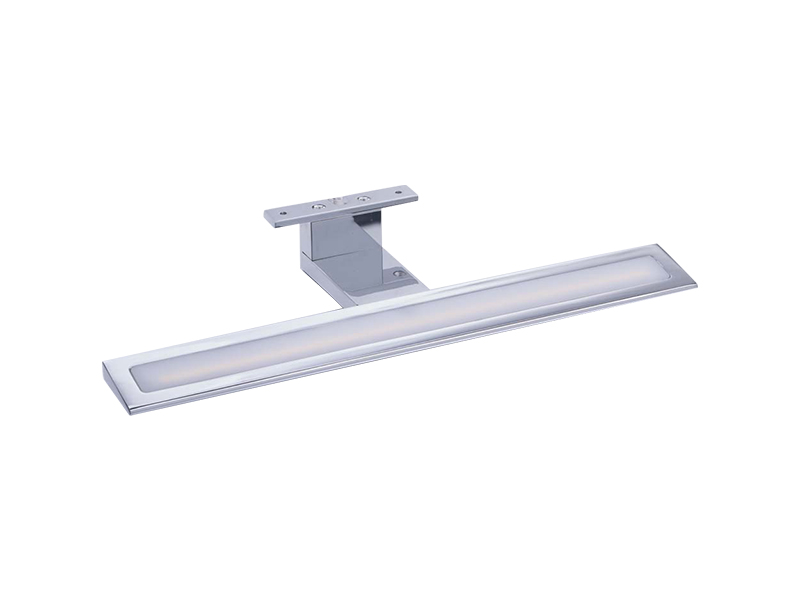 DK2512 Backlit LED Mirror Dimmable Light and DefoggerBacklit bathroom mirror light with dimmable lighting, defogger, and 3100K/4100K/6400K options; useful when reviewing dimming performance and lumen-maintenance documentation.View Product →
| Parameter | Halogen mirror light | LED mirror light |
|---|---|---|
| Efficacy | About 10-20 lm/W | About 80-110 lm/W |
| Rated life | 2,000-4,000 hours | 25,000-50,000 hours |
| Heat at the glass | High, warms the mirror edge | Low, heat moves to driver and pad |
| Dimming | Mains dimmer, often hums | Driver-based, smooth to 5 percent |
| Colour control | Fixed warm white | Switchable 3000/4000/6000 K typical |
| Typical supply | 220-240 V direct | 12 V or 220-240 V with driver |
Treat these as catalog-level ranges, not promises for one model. A serious supplier will send a datasheet plus the LM-80 and TM-21 data behind the lumen maintenance figure.
Fogging is a physics problem, not a checkbox. A demister pad raises glass temperature a few degrees above ambient so condensation cannot settle. If the pad is undersized or bonded only in the centre, the corners stay misted and the customer blames the whole mirror.
Practical numbers to request: a 15-30 W pad on a 0.5-0.8 m² mirror should clear the surface in roughly 5-10 minutes at 20 °C and 70 percent relative humidity. Ask how the pad is fixed, how many watts per square metre the supplier works to, and whether the defogging circuit runs on the same driver or a separate feed.
Then look at the enclosure. IP44 is the working minimum for the zone above a basin; IP65 earns its cost beside a shower or in hotel bathrooms. Chrome and aluminium parts should pass a neutral salt spray test, 48 hours as a minimum and 96 hours for coastal projects. It helps to read up on how bathroom LED mirror lights hold up in long-term humidity before you finalise the finish.
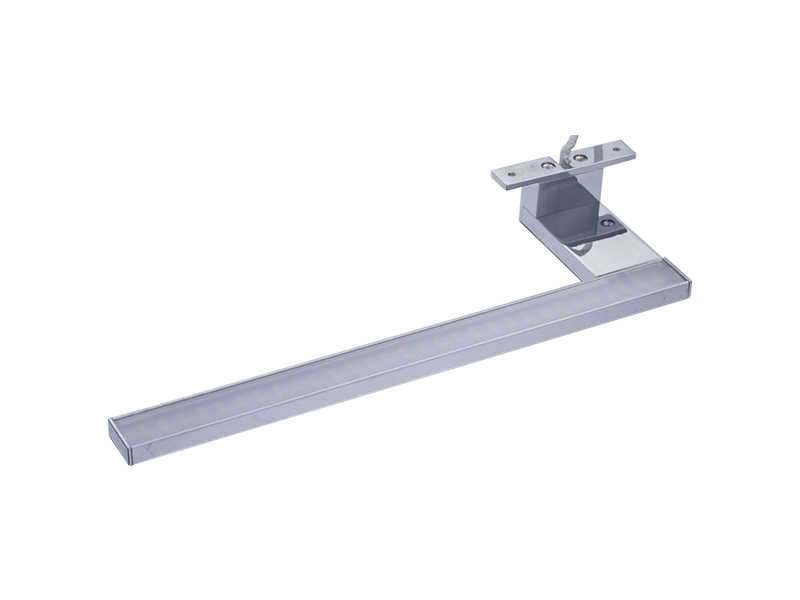 DK2511 Anti Fog Bathroom LED Mirror LightAnti-fog bathroom mirror light in aluminum with IP44 and 3100K/4100K/6400K options; review when enclosure durability and model-specific certification documents are priorities.View Product →
A certification logo on a website proves nothing. The report must name your model number. For Europe, expect CE marking supported by LVD 2014/35/EU and EMC 2014/30/EU reports, plus RoHS and ErP documentation. For North America, ETL or UL listing covering the luminaire and the LED components. Australia and New Zealand work on RCM, and Gulf projects usually ask for SASO or G-mark.
Request the luminaire report to IEC 60598-1 and IEC 60598-2-1, the IP test to IEC 60529, and separate certificates for the driver. Buyers who skip the driver certificate usually discover the gap when a retailer's QC team or a customs officer asks for it.
Purchase managers lose more time to optimistic schedules than to price. For a custom LED mirror light with new tooling, plan around 45 days from confirmed specification to loading. A repeat order in an existing housing usually runs 25-30 days.
Commercial terms matter as much as the calendar. Typical arrangements: sample fee refundable against the first bulk order, MOQ from 200-500 pieces per model, 30 percent deposit with the balance against a copy of the bill of lading, and pre-shipment inspection at AQL 2.5 major and 4.0 minor. Ask for a 4-8 hour aging record per batch, and confirm carton artwork, model number and voltage before the goods leave the building. Workdays in China affect the schedule around Chinese New Year more than any other factor.
A mirror-light catalogue usually splits into four families, and picking the wrong one costs more than any component upgrade:
Above-mirror bars suit low ceilings and quick installations. Backlit mirrors suit new-build bathrooms where the wiring can be planned. Corner and telescoping models solve tight layouts where the mirror sits close to a shower screen and the light must not glare into the eyes.
 DK1037 LED Bathroom Vanity Light Above MirrorAbove-mirror vanity light in stainless steel with IP44 and 3100K/4100K/6400K options; review for low ceilings or quick above-mirror installations.View Product →
None of this is exotic. It is the difference between a supplier who answers with documents and one who answers with adjectives. If a factory cannot send a driver certificate or an aging record for your model number, the quoted price is not a bargain, it is an unfinished calculation. Send your specification first, compare quotations on the same bill of materials, and the shortlist will look very different from where you started.
top

E-mail:[email protected]

Telphone:+86-574-88073028

FAX:+86-574-88073029
QR code on
mobile phone