
 English
 Español
 中文简体
News
Home / News / Industry News / Cylindrical Halogen Mirror Light: Specs, Heat Limits and a Buyer's Checklist
A failed mirror light rarely stops a project because of its light output. It stops because the replacement housing no longer covers the hole in the mirror, or because the lamp base it needs is not stocked within 300 km of the site. That is why the cylindrical halogen mirror light keeps appearing in bathroom specifications: a simple tube-shaped body, a capsule lamp that any maintenance technician can swap, and a warm, smoothly dimmable beam that flatters faces in a way that budget LED modules often do not.
The short answer before the detail: specify a cylindrical halogen mirror light when you need warm light, field-replaceable lamps and low tooling cost. Avoid it when the fixture will run many hours a day, when an energy code applies, or when the enclosure is too tight to let a halogen capsule breathe. The rest of this article explains how to tell those cases apart and what to write into the purchase order.
It is a mirror or vanity luminaire built around a tubular body, usually 40–60 mm in diameter and 100–300 mm long, mounted on a wall plate above or beside the mirror. Inside sits a halogen capsule lamp, normally behind a glass or opal diffuser, sometimes in an open-ended tube. The cylinder is not decoration: the rotational shape spreads light along its length rather than throwing a single hot spot, which is exactly what a narrow mirror needs.
It is worth being clear about what this product is not. It is not an integrated LED fixture, so the light source is a service item rather than a sealed assembly. It is not a sealed luminaire, so the IP rating on the label matters. And it is not automatically dimmable with whatever dimmer is already on the wall — halogen is resistive and dims well on leading-edge triac dimmers, but the transformer or driver upstream still has to suit the load.
The practical appeal is serviceability. A hotel with 80 bathrooms can hold twenty spare capsules in a cupboard and keep every mirror working for a decade; an integrated LED fitting that fails means a whole luminaire replacement and a possible visual mismatch with its neighbours.
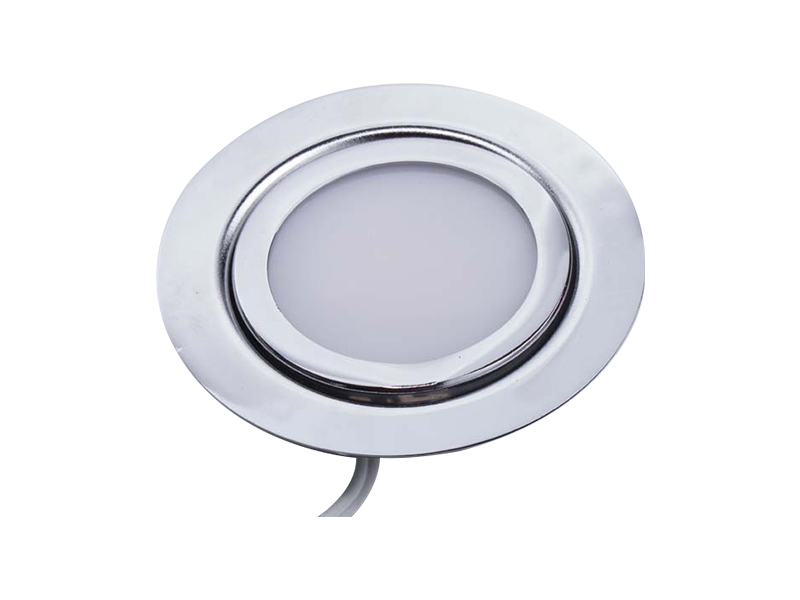
 DK664 Cylindrical Halogen Mirror Light with G9 CapsuleCylindrical halogen mirror light in aluminum with a chrome finish, IP44 and 33 W G9 specification, available with custom-made options for serviceable mirror lighting.View Product →
Most complaints about halogen mirror lights trace back to a specification that was left blank on the purchase order. These are the five fields that matter.
| Family | Typical housing | Mounting | Where it fits | Check before ordering |
|---|---|---|---|---|
| DK664 cylindrical halogen mirror light | Tubular body | Wall plate above or beside the mirror | Long, even wash on narrow mirrors | Lamp base and cylinder diameter |
| DK552 halogen lamp for mirrors | Compact body | Mirror clamp or wall plate | Small powder rooms | Fixing centres |
| DK865 halogen chrome mirror light | Chrome-plated metal | Wall mounted | Polished chrome bathroom schemes | Plating quality on edges and joints |
| DK932 aluminum halogen mirror light | Aluminum | Wall mounted | Humid rooms and coastal projects | Anodised versus painted finish |
| DK925 wall-mounted halogen mirror light | Wall bracket body | Direct wall mount | Retrofit over an existing wiring point | Backplate size against the old hole |
 DK-932 Aluminum Halogen Mirror Light, Chrome or SatinAluminum halogen mirror light in chrome or satin, rated IP44 and 48 W, with custom-made options for mirror and bathroom lighting projects.View Product →
A halogen capsule converts roughly 90% of its input power into heat. A 40 W lamp in a small metal tube reaches envelope temperatures well above 200 °C, which is enough to scorch a thermoplastic holder, discolour a painted ceiling above the fitting and burn a finger during a lamp change. Three design habits keep this under control: a ceramic or porcelain lamp holder rather than a plastic one, a metal body that conducts heat away from the capsule, and 20–30 cm of clear space above the fixture.
Input power needed for roughly the same light output (typical values, illustrative only)
The trade-off is not only energy. Halogen gives a continuous spectrum with a colour rendering index close to 100 and dims towards a warmer tone as voltage drops, which many specifiers consider flattering in a bathroom. LED wins on running cost and lamp life — typically 25,000 hours against 2,000–3,000 for a capsule — but the two are solving different problems.
For projects that land on the LED side of that tree but still want the mirror-mounted look, a wall-mounted LED mirror light is the direct equivalent and removes the lamp-change routine entirely.
 DK2515 Wall Mounted Bathroom LED Mirror LightWall-mounted LED mirror light with IP44 rating, 4.5 W output and selectable 3100K, 4100K or 6400K color temperatures for bathroom mirror lighting.View Product →
Three installation faults account for most of the returns we see. The first is a backplate smaller than the hole it has to cover, which turns a ten-minute job into a tiling repair. The second is a cable entry on the wrong side of the body, forcing the installer to route flex across the mirror. The third is mounting a halogen body directly under a low ceiling with no clearance, so the capsule overheats and fails within weeks.
Electrical safety deserves its own line in the specification, particularly in bathrooms where zones and earthing rules differ between markets. If your team needs a refresher before the next project, this note on safety concerns around mirror light installation covers the practical checks. For 12 V versions, confirm the transformer is rated for the halogen load and is accessible for replacement — a sealed driver buried behind tiles is a future problem, not a solution.
A halogen mirror light is a mature product, so the difference between a smooth order and a difficult one is almost always paperwork. Include the following and most ambiguity disappears before the first sample is made:
Custom work is where a manufacturer's process shows. Ningbo Eastkey has been building mirror and cabinet lighting since 2007 and states that customised orders are a normal part of its business, with enquiries answered within 12 hours on working days. Buyers who want to compare shapes, finishes and lamp options before committing to a drawing can review the halogen mirror light range and shortlist the bodies that match their mirror dimensions.
A cylindrical halogen mirror light is not a compromise choice — it is a specific tool for warm, serviceable vanity lighting in projects where lamps can be changed and heat can escape. Get the lamp base, the IP rating, the backplate size and the clearance right, and the fitting will quietly do its job for years. Get them wrong, and no amount of light output will save the installation.
top

E-mail:[email protected]

Telphone:+86-574-88073028

FAX:+86-574-88073029
QR code on
mobile phone